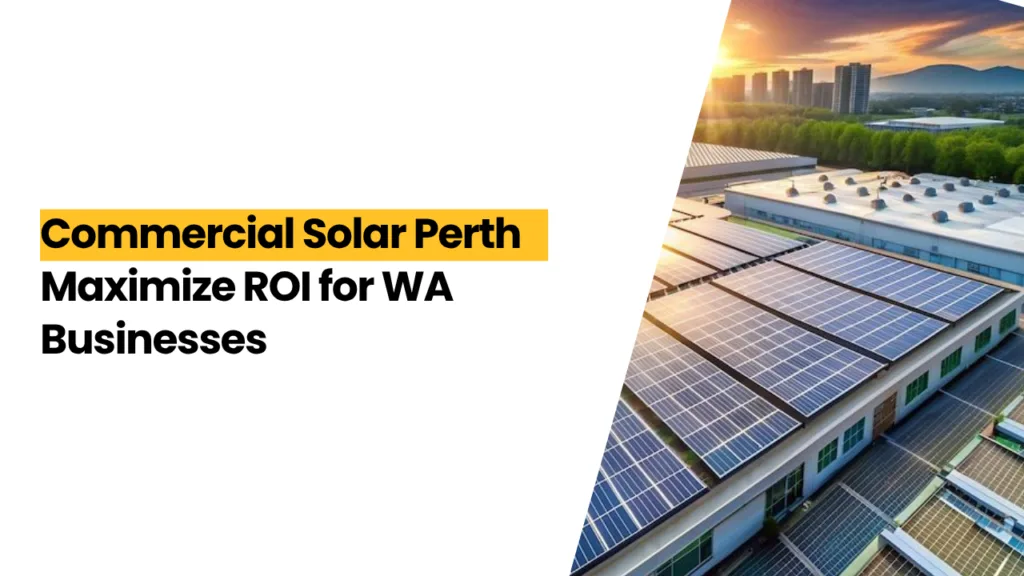
Commercial solar can help Perth businesses lower daytime electricity costs, make better use of unused roof space, and improve long-term energy planning. The strongest return comes from matching system size to actual consumption, choosing quality equipment, and designing the installation around how the business operates.
How can commercial solar improve business ROI?
Commercial solar can improve ROI by producing electricity when many businesses are already using the most power. Offices, warehouses, workshops, retail stores, and other commercial properties can use solar generation during operating hours instead of purchasing as much electricity from the grid.
This is where commercial solar Perth becomes particularly practical. A business with strong daytime electricity demand may use a large portion of its solar generation directly, reducing reliance on grid electricity.
The goal isn’t simply to install as many panels as the roof can hold. It is to build a system that works with the company’s actual energy habits.
Why is daytime energy use important?
Daytime consumption is one of the biggest factors when assessing a commercial solar project because solar generation naturally peaks during daylight hours. Businesses operating during those hours may therefore be well positioned to use their generation directly.
For example, a warehouse running refrigeration, lighting and machinery throughout the day may have a very different solar profile from an office that becomes quiet after 5 p.m.
A proper assessment should examine electricity bills, operating hours, seasonal demand and major equipment before system sizing begins.
What should businesses consider before installing solar?
The best commercial solar systems Perth projects start with the business rather than the equipment catalogue. Before choosing panels or an inverter, businesses should understand how much electricity they use, when they use it, and how much suitable roof space is available.
Electricity demand: Review recent bills to identify consumption patterns.
Roof condition: Make sure the roof is suitable for the expected installation lifespan.
Operating hours: Compare business hours with the expected solar generation window.
Future plans: Consider expansions, new machinery, or changes in premises before finalising system size.
Energy goals: Decide whether the priority is lower bills, sustainability, energy independence, or a combination.
This preparation prevents a common mistake: paying for a system that produces more electricity than the business can effectively use.
How big should a commercial solar system be?
There is no universal system size for every Perth business. The right capacity depends on electricity consumption, roof area, available connection capacity and the percentage of solar generation the business can use.
A small professional office may need a very different setup from a large warehouse or manufacturing facility.
| Business type | Typical daytime demand | Solar planning priority |
| Office | Moderate | Match generation to working hours |
| Retail | Moderate to high | Consider lighting and HVAC |
| Warehouse | High | Examine roof space and equipment |
| Workshop | High | Match system to machinery loads |
| Manufacturing | Very high | Detailed energy assessment |
The numbers should come from the business’s actual electricity data rather than an arbitrary panel count.
What does commercial solar installation Perth involve?
Commercial solar installation Perth generally involves site assessment, system design, electrical planning, approvals, equipment installation, and testing. Larger projects can require more detailed engineering and connection considerations than a typical residential installation.
The roof itself also matters. Orientation, shading, structural condition, and available space can influence how much useful generation the system produces.
A quality commercial solar power installation Perth project should therefore be designed around the building and its energy requirements rather than using a standard residential approach on a larger roof.
How much is commercial solar energy Perth businesses using?
Commercial solar energy Perth is becoming increasingly relevant as businesses look for ways to manage electricity costs and improve their sustainability credentials.
The Clean Energy Council reported that rooftop solar provided 12.8% of Australia’s electricity generation in the first half of 2025, with more than 4.2 million Australian homes and businesses having rooftop solar installed.
That national figure isn’t a direct measure of commercial ROI in Perth, but it shows how quickly rooftop solar has moved into mainstream energy use across Australian businesses and households.
How can businesses calculate solar ROI?
A useful ROI assessment compares the system’s total cost with the value of electricity it helps the business avoid purchasing, along with other applicable financial benefits. Instead of focusing only on the initial quote, consider:
Annual energy savings: Estimate how much solar electricity the business can actually use.
System cost: Include panels, inverters, installation, electrical work, and other project expenses.
Operating costs: Allow for monitoring, maintenance, and potential component replacement.
System lifespan: Consider the expected useful life of the equipment.
Payback period: Estimate how long the savings may take to recover the initial investment.
The result gives management a clearer picture of whether solar makes financial sense.
What makes commercial solar panel installation Perth worthwhile?
Commercial solar panel installation Perth can turn otherwise unused roof space into an energy-generating asset. For businesses with suitable roofs and strong daytime consumption, this can make the property more productive without changing the core operation.
Solar can also give businesses greater visibility over a portion of their future electricity costs. However, the financial case should always come first. A system should be sized for useful generation, not simply maximum roof coverage.
How should a business approach solar installation?
A sensible project can be broken into a few clear stages.
1. Review energy bills
Look at at least several months of electricity consumption and identify when demand is highest.
2. Inspect the property
Assess roof space, shading, structural condition, and electrical infrastructure.
3. Model the system
Estimate expected generation and compare it with the business’s daytime consumption.
4. Compare equipment
Look at panel performance, inverter quality, warranties, and monitoring features rather than choosing solely on price.
5. Review the financial case
Consider expected savings, project cost, payback period, and long-term performance.
6. Plan the installation
Work with an experienced commercial solar installer in Perth who understands larger electrical systems and commercial requirements.
What should businesses know about solar commercial Perth projects?
Solar commercial Perth projects work best when solar is treated as a long-term business investment rather than simply a building upgrade.
A company should know what it expects from the system before construction begins. That might mean reducing electricity purchases, improving sustainability reporting, or making energy costs easier to manage.
The same principle applies to a commercial solar power system Perth business: the technology should serve the business strategy, not the other way around.
What should you ask a commercial solar installer?
Before signing a contract, ask about system performance, warranties, monitoring, installation standards and expected generation.
You should also ask how the proposed system was sized and whether the calculations were based on your actual electricity consumption.
A reputable commercial solar installer in Perth should be able to explain the reasoning behind the design in straightforward language.
FAQs
Are commercial solar systems Perth businesses worth it?
It can be, particularly for businesses with substantial daytime electricity consumption and suitable roof space. The financial result depends on system cost, energy use, generation, tariffs, and how much solar electricity the business can use.
How long does a commercial solar system last?
Solar panels are designed for long-term operation, often with warranties extending for decades. Other components, such as inverters, may have different expected lifespans and warranty periods.
Can warehouses benefit from commercial solar?
Yes. Warehouses often have large roof areas and significant daytime electricity demand, making them potentially suitable for solar. Their suitability still depends on roof condition, energy consumption, and electrical infrastructure.
Does solar work during cloudy weather?
Solar panels can still generate electricity during cloudy conditions, although output is lower than on a bright sunny day. The actual reduction depends on cloud cover, panel orientation, and system design.
Can solar reduce a business’s electricity bills?
Yes. Solar can reduce the amount of electricity a business needs to purchase from the grid when the system is generating. The size of the reduction depends heavily on the business’s consumption pattern.
How can commercial solar Perth benefit a business?
Commercial solar Perth can help businesses reduce their reliance on grid electricity by generating power on-site during operating hours. It can also make better use of available roof space and support more predictable long-term energy planning.
Could MJM Solar help your business explore solar?
A commercial solar project deserves more than a quick panel count and a generic quote. The strongest investment starts with understanding how your business uses electricity, then building a system around those real numbers.
If you’re exploring commercial solar Perth for your business, MJM Solar can help you assess your energy needs, understand your options, and develop a solar approach focused on practical long-term value.